

A Census Bureau working paper published in September found that graduates in the most AI-exposed tenth of college majors, led by computer science and engineering, saw their chance of being employed in the quarter after graduation fall five points once ChatGPT arrived, and their starting earnings fall thirteen percent. Two years out the earnings gap had narrowed but not closed. The authors compare it to graduating into a large recession.
That paper landed three months after the Department of Education’s final rule of July 1, 2026 (91 FR 40136) set the mechanics of the first earnings test that applies to every degree program in the country. Starting in 2027, each program will be judged on whether its completers out-earn a high school graduate four years after finishing. Fail twice in three years and the program loses federal loans.
Here is the problem. The test’s first run, in early 2027, scores students who completed in award year 2021 on their 2025 earnings. The last public PSEO release, the Census series that follows graduates by program, ends with the class of 2019 to 2021. The College Scorecard update of October 15 measures one-year earnings on completers from 2021 and 2022. The Census paper dates the break to November 2022. The accountability system is about to grade a field on a labor market that no longer exists.
What the record shows for those fields
I grouped bachelor’s programs by the Opportunity Data AI Exposure Index and pulled every cohort the public PSEO record contains. For the most exposed tenth of majors, median earnings one year after graduation rose from about $54,000 for the class of 2001 to about $72,000 for the class of 2019, in constant dollars. A third, in real terms. The least exposed fields gained about a tenth. The floor rose faster than the ceiling: the 25th percentile in the most exposed fields climbed 39 percent while the 75th climbed 17.
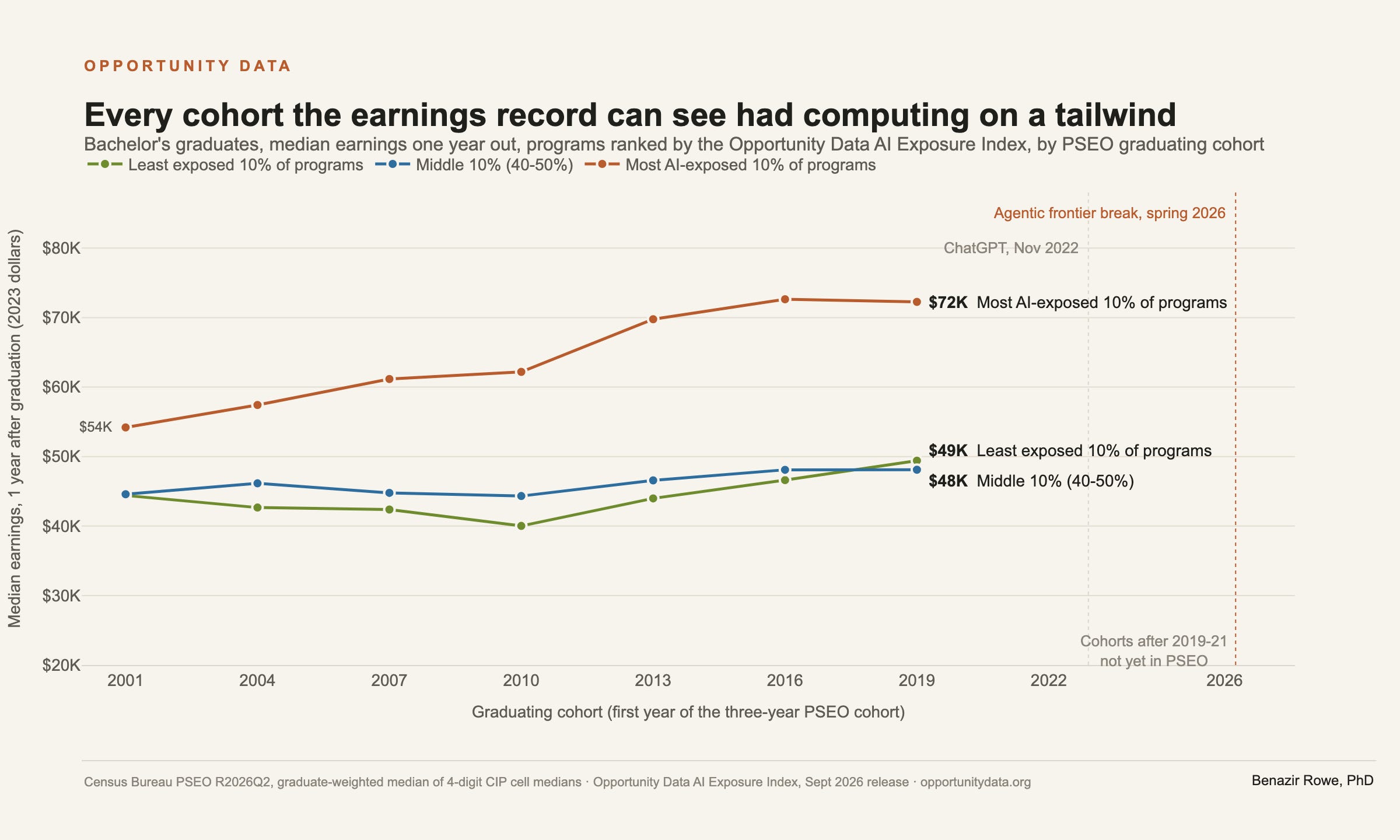
Every number in the public record was produced during the best twenty years computing graduates have had. The test’s own first reading will not correct this. It measures the 2025 earnings of people who entered the market in 2021, before the break, and the Census paper finds the damage falls on people entering the market, not on people already in it. The test will pass these programs easily, and it will keep passing them, because the lag is not a year or two. A student who entered the market in 2023 is measured in 2027 and reported in 2029. Two failing years out of three means nothing can happen before 2031. Small programs are measured on completers going back as far as seven award years, so a 2029 calculation can rest on students who finished in the 2019-20 award year.
What is happening now
The only public data that can see graduates who finished after ChatGPT is the American Community Survey, which records field of degree. I took bachelor’s degree holders aged 22 to 24, not enrolled, and grouped their majors by the index.
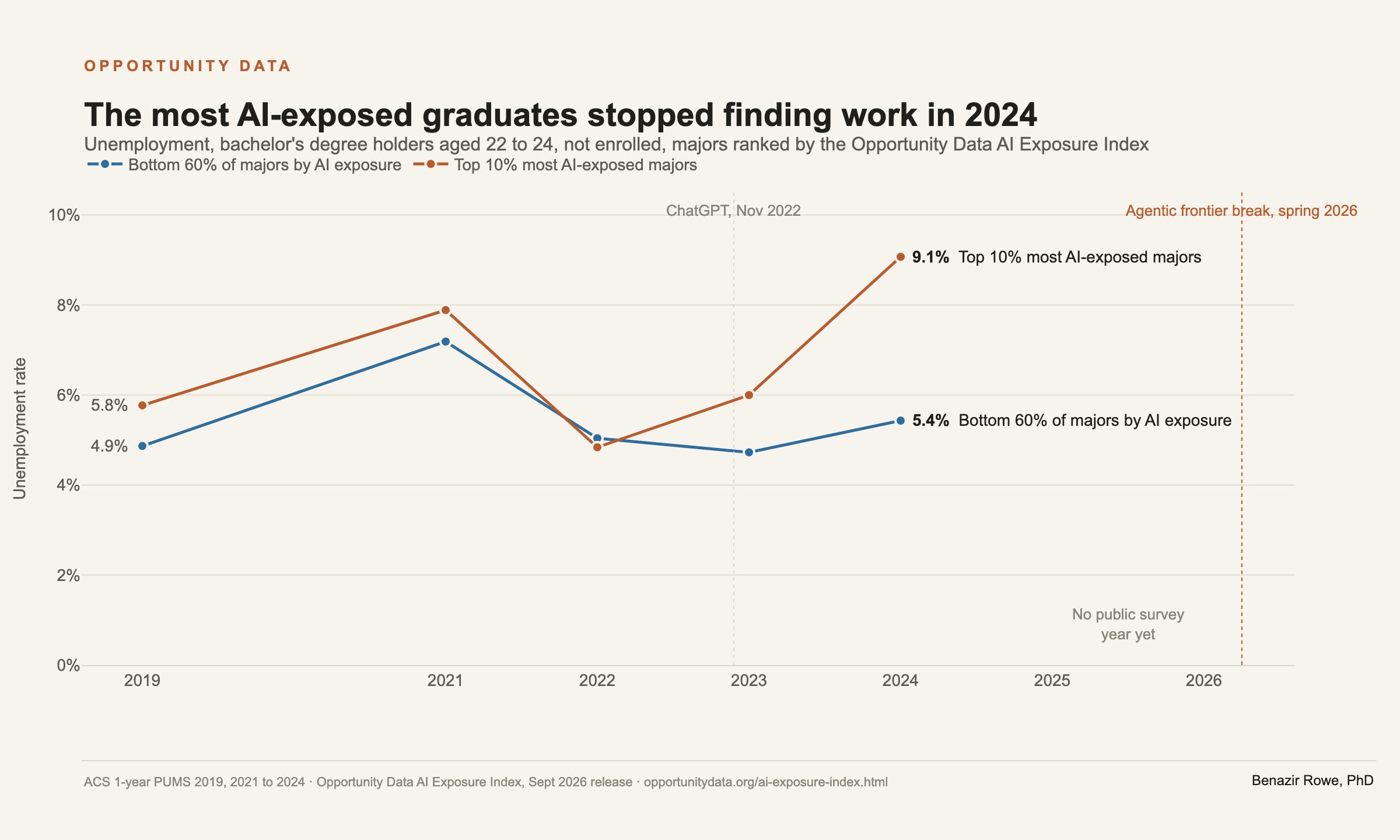
Unemployment in the most exposed tenth of majors went from 4.8 percent in 2022 to 9.1 percent in 2024. The least exposed six tenths went from 5.0 to 5.4.
The same thing shows up if I use the Census paper’s grouping instead of Opportunity Data AI exposure index.
Pay did not fall. Among full-time workers aged 22 to 27 in these fields, every percentile from the 10th to the 75th is within three percent of its 2019 level in 2024, in constant dollars, and the 90th rose ten percent. The people who got the jobs got paid. Fewer people got the jobs.
And all of that is the small shock. The Census paper’s event is a chatbot, and its data end in mid-2025. The agents that arrived this spring, the ones that write and run software end to end, do not appear in it, or in the survey years I used, or in anything else that is public. The Opportunity Data AI Exposure Index is built for that later frontier; the Census paper measures the earlier one. The first public survey that will see graduates who finished after the agentic break is the 2026 ACS, due late next year. If the spring 2026 systems are a second shock, as the index assumes, the earnings test is not one data generation behind the labor market. It is two.
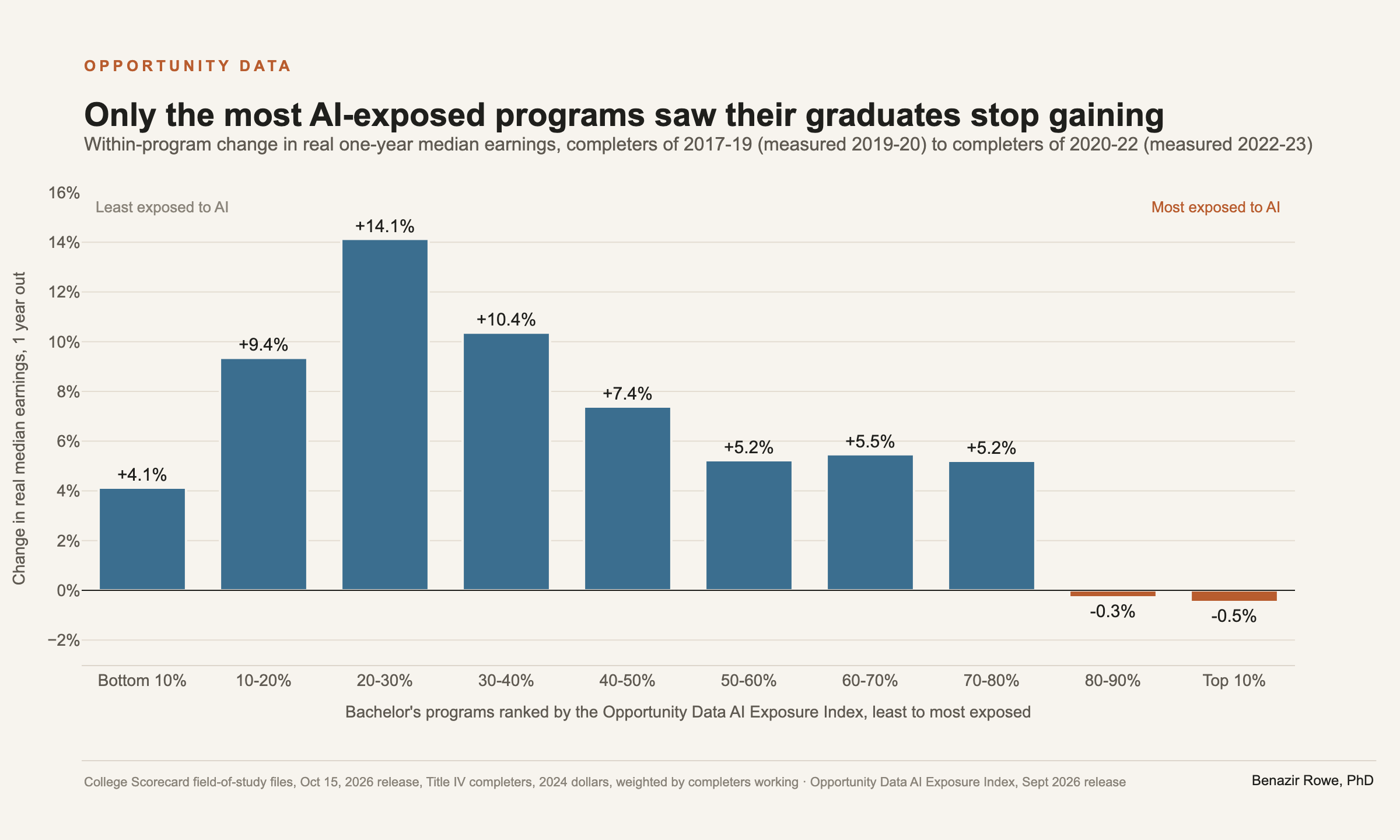
There is one program-level record with an earnings year after the break, and it has started to fall behind. The College Scorecard’s newest one-year earnings cover graduates of 2020-21 and 2021-22, measured in 2022 and 2023. Matching programs across its three cohorts and grouping them by the index, real one-year earnings in the most exposed tenth of programs were flat while every other decile gained between 4 and 14 percent. The record the earnings test will read next is already moving in the direction the Census paper predicts.
Students are not waiting for the data. The National Student Clearinghouse’s preliminary fall 2026 numbers, released October 29, show computer and information science enrollment down 12.4 percent at four-year schools and 12.3 percent at two-year colleges in a single year, while health enrollment rose at every level. Matt Dembicki’s write-up at Community College Daily puts the drop at community colleges over the last two falls at 17.5 percent. The field the earnings record rates most favorably is the one students are leaving fastest, and the test that is supposed to reconcile those two facts cannot score a post-ChatGPT cohort before 2029.
Why the test cannot see it
That last fact is the one that matters for the July 2026 earnings-test rule. Under 34 CFR 668.403, the test takes the median of completers “who are working and not enrolled during the calendar year in which earnings are measured” (91 FR 40137), and working means any positive wage, salary, or self-employment income reported to the IRS that year. A graduate with no paid work in the year does not lower the median; they are dropped from it. That is a change from the gainful employment rule this one replaces, and the Department said so in the preamble, explaining why fewer programs will fail:
Fewer of these programs are expected to fail the earnings test under the final rule because ... it measures the median earnings of working individuals only (whereas the current rule measures the earnings of all completers regardless of whether they are working). (91 FR 40145)
The benchmark on the other side, the state median for high school graduates aged 25 to 34, is built the same way, and the Department declined to put an income floor on either side.
The STATS earning test is a floor on pay conditional on having worked at all. A graduate who was jobless the whole year is invisible to it, and the change both the Census paper and the survey find is on the employment margin, not the pay margin.
The Department has already accepted the principle that a measurement year can be non-comparable. Programs for tipped occupations get neither a pass nor a fail for any year that uses 2025 or earlier earnings, because the tax treatment of tips changed. A labor-market shock in a specific set of fields is the same kind of problem, and the fields it hit are the ones the record currently rates most favorably.
What next
The instrument has a lag. For two decades the record understated how well computing paid, because each new cohort did better than the last. From here it is likely to overstate it for the same reason. The decisions it informs now include which programs states approve and which colleges keep, and each will rest on the earnings of graduates who entered the market six to ten years before the decision.
Unemployment in the most AI exposed majors went from 4.8 to 9.1 percent in two years. Nobody knows yet whether these majors need fewer graduates or just different ones. The earnings test will not ask until 2029, and federal loans will pay for the current curriculum until then.
The ACS publishes field-level unemployment among recent graduates every year, under twelve months after the fact. The earnings test will not read a post-ChatGPT cohort until 2029. The 2024 ACS already has.
The full analysis, with every chart, the data files, and the sensitivity checks, is on Opportunity Data. The methodology note documents each series.
Benazir Rowe, PhD is the founder of Opportunity Data, an independent research platform that tracks state implementation of Workforce Pell and measures occupational and educational exposure to AI. Data, methods, and the analysis behind this post are at opportunitydata.org.