Introducing Opportunity Data: A Better Way to Support Student-Centered Workforce Advising
As interest in short-term credentials grows, so does the need for better tools to help students navigate them well.

A recent NCAN survey on workforce advising highlights something important: students are actively asking about short-term workforce programs, and that demand is only growing. Across NCAN’s respondents, 85% said students ask about these programs at least occasionally, with health programs, skilled trades, and CDL among the most requested areas. But only a small share said advisors feel very confident guiding students through those choices.
That gap matters because short-term credentials are becoming a more important part of how students pursue opportunity, speed to employment, and economic mobility. As Workforce Pell moves toward implementation, students, advisors, and institutions will need better ways to understand which programs lead where, for whom, and with how much uncertainty. The urgency is real, but so is the opportunity to build better information around those decisions.
That is what motivated me to build Opportunity Data. It is a public, verifiable resource designed to make workforce outcomes easier to interpret for students, educators, and policymakers. Using public PSEO earnings data, the site shows what happens after completion: how earnings evolve over time, how outcomes vary across students, and where the data is missing. The analysis focuses on short-term credential programs reported in PSEO across participating states and institutions.
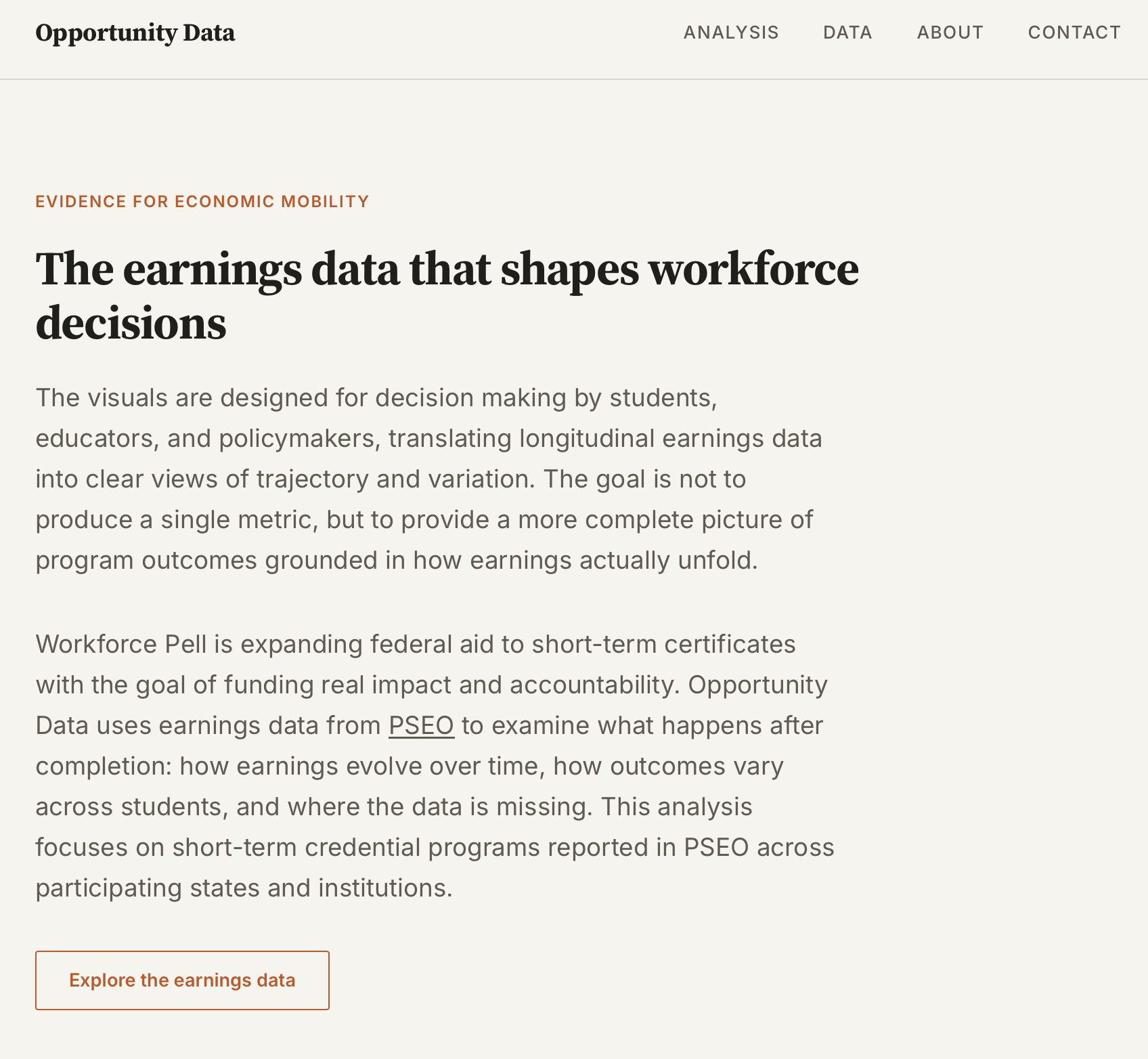
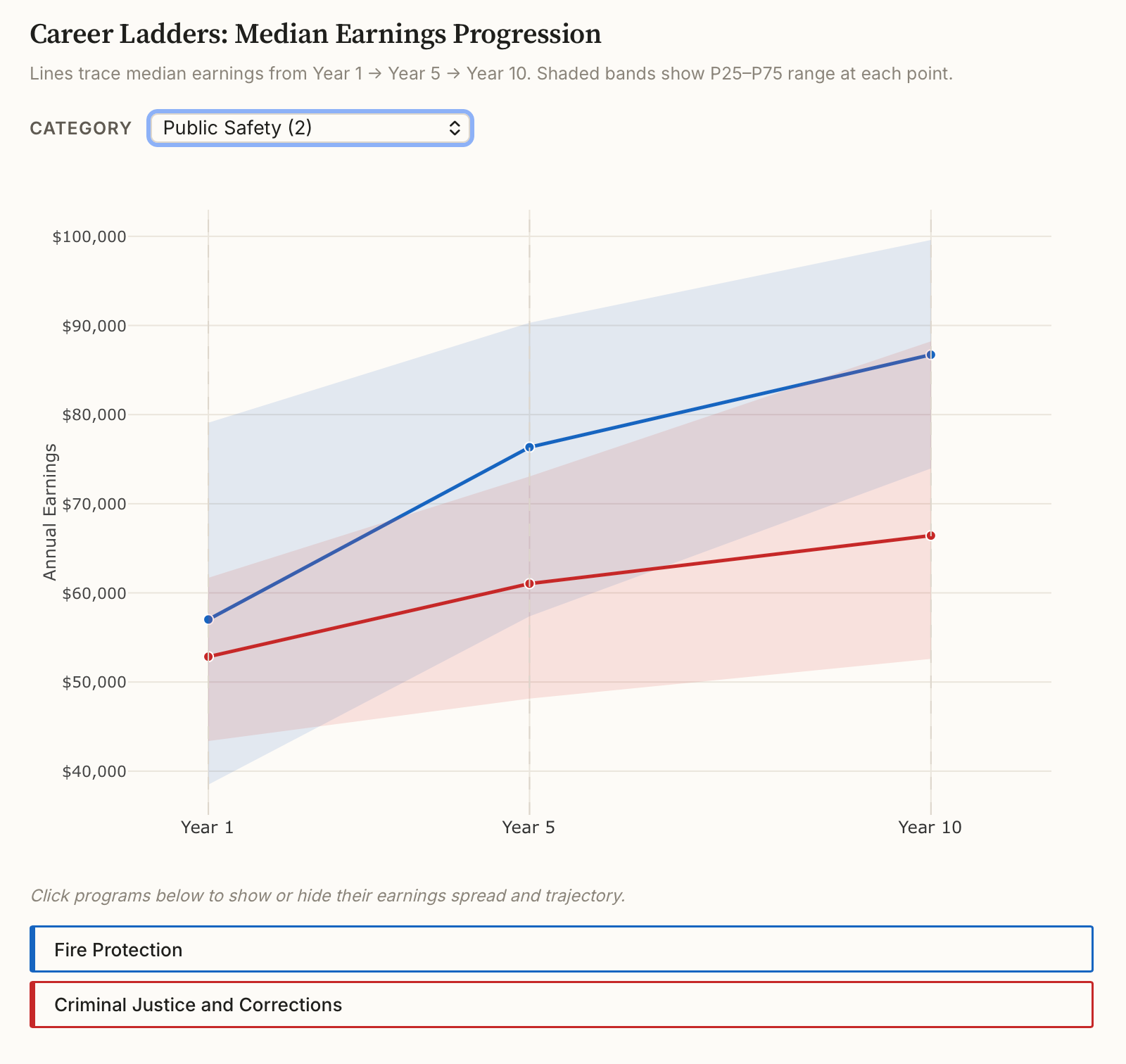
Most workforce conversations still collapse to a snapshot: first-year wages, average earnings, ROI. But short-term credentials often do not work that way. Many are entry points. Their value unfolds over time, through experience, labor market movement, and additional learning. That is why Opportunity Data is built around trajectory, not snapshot, with earnings shown at one, five, and ten years after completion.
It is also built around risk and spread. Students do not just need to know the average outcome. They need to know how much outcomes vary. Some pathways are more predictable. Others may have more upside, but also more uncertainty. Opportunity Data uses earnings variance, including the spread between the 25th and 75th percentile, because student-centered advising should be honest not just about opportunity, but about risk.
The site also makes missingness visible. Right now, Opportunity Data shows that 55% of programs covered in the underlying data have earnings fully suppressed because there are too few graduates to clear Census privacy thresholds. That is not just a technical footnote. It shows where the evidence base is still thin and where additional support is necessary.
That missingness matters for Workforce Pell implementation too. If federal aid is expanding into short-term credentials, then the gaps in the available outcomes data matter as well. Missingness helps make those gaps visible. It shows where policymakers, institutions, and researchers are being asked to make decisions without a full picture, and where the evidence infrastructure still needs work. I wanted the project to be transparent not only about what the data can show, but also about what it cannot.
My hope is that people use Opportunity Data as much as possible: to compare programs, ask better questions, and identify where the data is strong, where it is weak, and where the biggest blind spots still remain. The goal is not to pretend the evidence is complete. It is to make the current evidence more usable while making its limits much harder to ignore.
Opportunity Data currently covers short-term certificate earnings across 25 PSEO coalition states, spanning 500+ institutions and 10,000+ program-institution records. The visuals are designed for decision-making by students, educators, and policymakers, using public Census-reported data to show trajectory, variation, and missingness in a way that is easier to interpret. The PSEO Coalition member states page gives a broader sense of the institutions and systems participating in that ecosystem.
Students are already asking the questions. My hope is that Opportunity Data helps more people answer them with better evidence and also see, clearly, where the biggest gaps still are.